
Writing
Master first lines, plot and characters
Writing Popular Fiction with Lee Child
Learn from Lee Child how to hook readers from the first sentence, build intrigue, and craft page-turning popular fiction.
Hitching a ride on a strong first sentence
Unlock the secret to capturing the imagination of your readers and holding their attention from Page 1.
Lesson
Captions available
Duration
14 minutes
Course notes PDF
Maestro
Rating
Explore lesson transcript
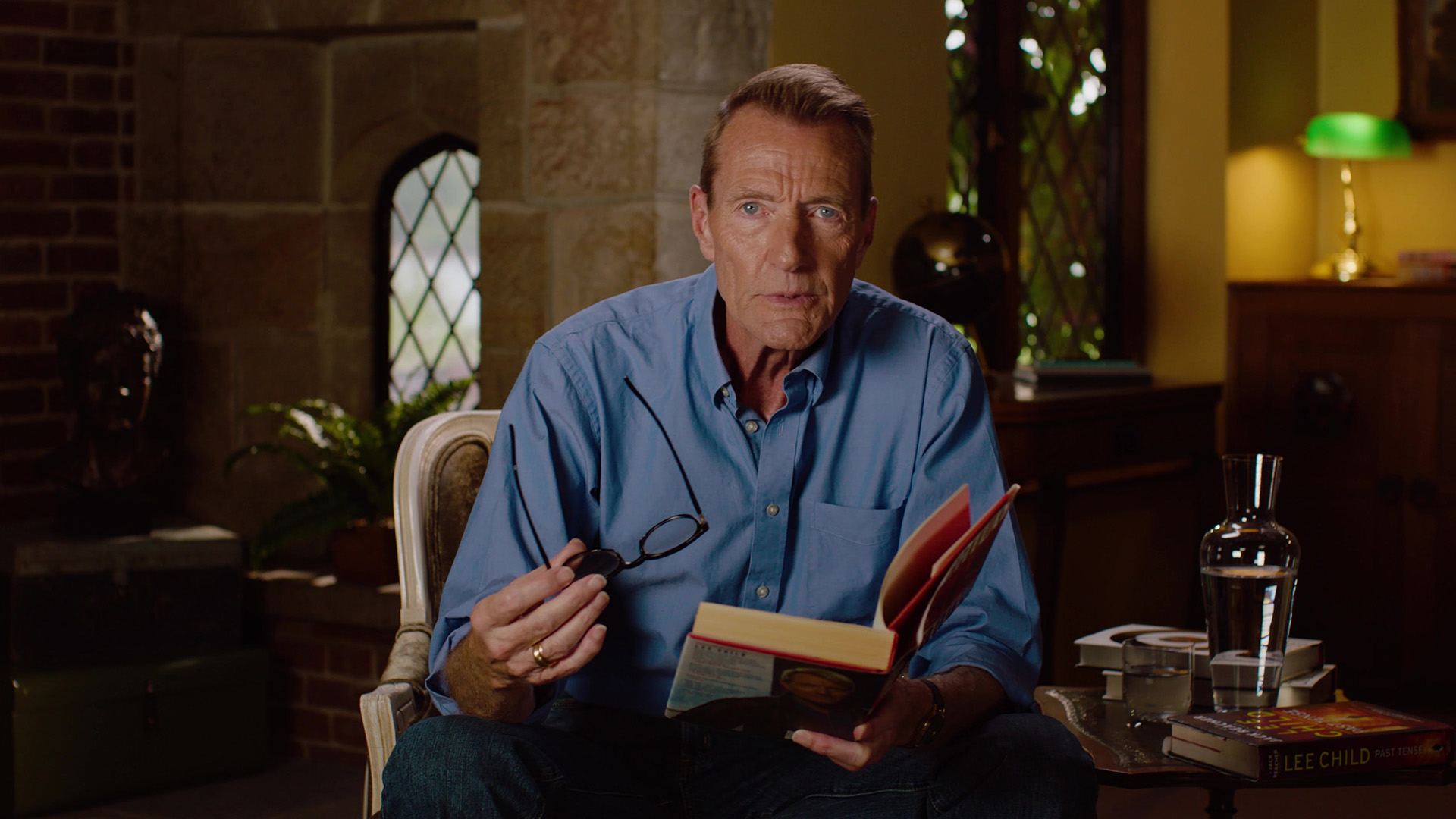
So how do you start your book? Well, that's obvious. With the first line. And the first line is a very important delicious, delightful line. It is, for me anyway, an absolutely gorgeous feeling to sit down there with a blank screen type the first line. You're up and running. And the first line has a very important role to play but it's got to play it very subtly. It's got to play it unobtrusively. What is it there for? It's there to say hello, effectively to the reader. The reader picks up the book probably kindly disposed toward it otherwise they would've picked up another book. They are interested, and they open it and the first line is the book saying hello. But it's also the book making a promise. What is the book going to be about? Is it going to be compelling? So the first line has got a lot of weight on it. But you can't overreact to that. You can't take it too importantly. What you do not want is a first line that begs or pleads for attention. It's got to be intriguing. It's got to be somehow fascinating. It's got to tempt them to read on. But it can't be too bold. It can't be too crass or obvious. It's got to be somewhat subtle. It's got to carry an implied promise without waving too much of a flag about it. So what I'm going to do is read a few from my books and talk about them. Try and analyse what they're doing and why. When I say "first line" do we mean first sentence, or the actual second sentence if it's there on the first line and so on? Do we mean the first paragraph? It's a blurred distinction, that. The first line itself is super important. But so are the next couple as well. So, it's not just about the first line. It's about the first paragraph or the first statement. So here we go, I'll show you what I did and why I did it to illustrate the points that I'm trying to make. So, my first book, *Killing Floor.* The first line of mine that anybody ever read. "I was arrested in Eno's diner." That's the first sentence. And what does that do for us? What does that do for the book? What does that do for the reader? It's a fairly plain statement. It's a record of what happened. "I was arrested." And where, "In Eno's diner." Well, "Eno's diner" sounds fairly intriguing. It's not a chain, it's not a national brand. It's obviously a local place somewhere. So immediately, the hint is we're in a small place possibly miles from anywhere else. It's an individual establishment. And the first half of the sentence "I was arrested" asks, really, two questions there. First of all, who are you? And secondly, why did you get arrested? Did you deserve to be arrested? Are you a bad guy? Were you arrested unjustly? Are you a good guy who's going to have to try and clear his name? Or what? Don't forget, when a reader picks up a thriller they are reading it with the background knowledge of every other thriller they've read. Therefore, "I was arrested" to them means probably unjustly. Because "I", the book's main character is starting out with the statement. The main character of a book is usually a good guy. Not always, but mostly. It can be mixed, can be an anti-hero, can be a bit noir but basically, we assume we're going to be on that person's side. So we assume that probably he's being arrested unfairly under dubious circumstances and we read on to find out exactly what happened. So I think "I was arrested in Eno's diner" is a good, serviceable first line. It doesn't beg or plead for attention. It doesn't try to make more than it should. It just stands there and it gives the reader an option of being interested or being not interested. And I think this one definitely leans towards being interested. I would be very surprised if anybody reads that first line and doesn't go on to read at least the first chapter. Here's another example. My seventh book, called *Persuader.* And this one is probably a little more sophisticated. Same system. It's going to promise something. It's going to imply something. It's offering something to the reader. But maybe it's a little more complex than the last one. It goes like this. "The cop climbed out of his car exactly four minutes before he got shot." OK, now that is... that is, I hope, compelling on two levels. First of all, why is a cop getting shot? What's going to happen that ends up with a cop being shot? Obviously some kind of dramatic, intriguing scene with a motivation and a reason and a result. But how do we know that this is going to happen exactly four minutes later? Now, technically, that's possible if this was a super omniscient narrator. Remember point of view. We talked about the different points of view you can have. If you are an omniscient narrator hovering 30,000 feet above the action you might be able to legitimately say this happened exactly four minutes before that happened. But such a narrative style is very unusual for a thriller. So the thriller reader instinctively is going to wonder how do we know what's going to happen exactly four minutes later? How do we know that? Is this pre-planned? Is it some kind of conspiracy? Is it some kind of sting? Is it rehearsed? Is it choreographed? Why exactly do we know about the four minutes? I think that's the strength of that line. And I think, again, that will power the reader through at least the first chapter. So the first line is something that you've got to make strong, make bold but do not make it desperate. Make it intriguing enough to deliver the reader to the next line and the next paragraph and the next page and give them a fair chance to make their own mind up, either yes or no about the book. Next example from *Gone Tomorrow.* This one, I think, is the most... probably the most compelling first line I'd written to that point, anyway. It goes like this. "Suicide bombers are easy to spot." Again, immediately in the reader's mind two things happen. First of all, "suicide bombers". OK, we're in a moment of extreme peril maybe. Maybe there's a suicide bomber in the vicinity. Maybe the stakes are already incredibly high. Maybe we're joining the action at a point of real tension. And of course, the other part of this sentence that intrigues the reader "are easy to spot." OK, how? How do you spot a suicide bomber? That particular line has a promise that we're going to find out how to spot a suicide bomber which theoretically could be important information. And it's a good example of how the first sentence carries weight, carries a lot of weight. It's the first sentence in the book. But it also contributes to the second and third sentence because the idea is to deliver the reader to the second sentence, and the third and the fourth and cumulatively, they do a job of work. So the first few sentences goes like this. "Suicide bombers are easy to spot. They give out all kinds of tell-tale signs. Mostly because they're nervous. By definition, they're all first-timers." The thing about "they're all first-timers" introduces a slightly sardonic, slightly knowing perspective. In other words, the person making this statement is probably familiar with such things and so straight away, the reader gets the impression OK, there's a suicide bomber possibly. And there's somebody who knows about suicide bombers who is possibly ready to take charge of the situation. So that's what that's doing. Again, intriguing. Again, tempting. Making a promise, making an offer to the reader but not desperately pleading for their attention. First lines have got to be bold. They've got to be confident. But they needn't be too desperate. Now we get a slightly different approach in this book, *Past Tense.* Slightly different approach, in as much as that this first line does not offer immediate action. It does not offer immediate tension and peril. It actually indicates the end of something that has come before. Goes like this. "Jack Reacher caught the last of the summer sun in a small town on the coast of Maine and then, like the birds in the sky above him he began his long migration south." So that is... obviously the end of summer, the beginning of autumn. Time to move on. The reference to Maine. It's a well-known summer destination, there's a lot of summer people there. At the end of the season, they start to drift away. And Reacher is taking part in that outward drift. He's moving on, as Reacher does, as everybody does in that part of the world. Does not offer much direct hint of action. Doesn't offer a hint of immediate peril. It's just a pleasant, rather bucolic, rather nature-based type of line. So, it was quite a... it was quite a commitment to start with a line like that. Because it's not "wham-bang". It doesn't promise anything immediate. It doesn't start in the middle of anything. It starts at the end of one season and the beginning of the next season. It's very transitional. But what it does for me, anyway, as a writer, that first line just came to me. It sounded good, I wanted to use it. And then after I'd written it I thought, "Why did I put in the birds in the sky above him?" What was my subconscious motivation for doing that? And partly it was to just populate the image with nature, with bucolic stuff, birds migrating, the end of summer, we can imagine the feel, we can imagine the smell of the coast toward the end of the summer. But what are the birds doing there? Well, overtly, like I said, I did it because I felt that was part of a nice image, part of a gentle image that would ease the reader into the story. But the more I thought about it, I figured is my subconscious helping me out there in terms of predicting the DNA of the story? Because much earlier, in one of the earlier Reacher books I had mentioned that his dad was a birdwatcher. At the time, I did that to humanise him. Because as well as that, he's also a Marine officer, an infantry officer and described as a "stone-cold killer". But because, I guess nobody really wants to think of their dad as a stone-cold killer, Reacher also remembers that his dad was a passionate birdwatcher, loved the little innocent creatures. So I asked myself, in doing that line, am I predicting to myself what the story is going to be about? Is Reacher's dad going to be involved in this story? And yes, he is, as a matter of fact because of that first line. I listened to my own subconscious there and thought, yeah, this is telling me the story's going to be about his dad. It's going to ease in gently and then it's going to build and build and build to a situation of tension. So, think about your first lines. Very important. A lovely feeling, a unique line in a book. The first line is the only line in the whole book that does not follow another line. So you've got infinite possibilities. You've got a task to do which is to hook the reader somehow not by beating them over the head with a club, not by blowing trumpets and shrieking "This is going to be an exciting book, I promise!" Stay restrained, stay calm. Try an intriguing line that holds out a hint of promise, an offer of excitement and a very slight indication possibly about what the story will contain.
What you'll learn
Join Lee on a creative journey as he shows you how to turn your blank page into a complete story.
- Craft a thrilling plot
- Switch narrator perspective
- Build complex characters
- Find your niche
- Write natural dialogue
- How you can make a living as a writer

With over 200 million copies sold worldwide and multiple awards under his belt, Lee Child is the undeniably successful author of the popular Jack Reacher book series, which have also been adapted for the screen with two blockbuster movies, as well as a new TV series on Amazon Prime. And to add to his inspirational success story, Lee Child is also living proof that it’s never too late to get started, as he only started writing at the age of 40 after being made redundant from his job.
Common Questions
-
How do I start writing my first novel?
Begin with a strong, intriguing first line that makes a subtle promise to the reader, then build plot and character together from the outset.
-
What is the secret to beating writer's block?
Focus on small, achievable writing tasks like drafting an opening sentence or paragraph, and keep the pressure low to stay productive.
-
How can I come up with strong story ideas?
Draw inspiration from everyday life, news stories or personal experiences, then ask 'What if?' to transform them into compelling plots.
-
How do I write the first chapter of my book?
Hook readers early with intrigue, avoid over-explaining, and let the first few lines raise questions that lead them deeper into the story.
-
What makes a good story in popular fiction?
A well-paced plot, memorable characters, and a first line that invites curiosity all combine to keep readers turning the pages.
-
How should I structure my creative writing?
Think of plot, character, dialogue and setting as interconnected, evolving elements rather than isolated steps in the process.