
Writing
Beating writer’s block and finding story ideas
Writing Thrillers with Harlan Coben
Overcome writer’s block, spark new ideas and master storytelling with Harlan Coben’s proven thriller-writing techniques.
Reframing writer’s block
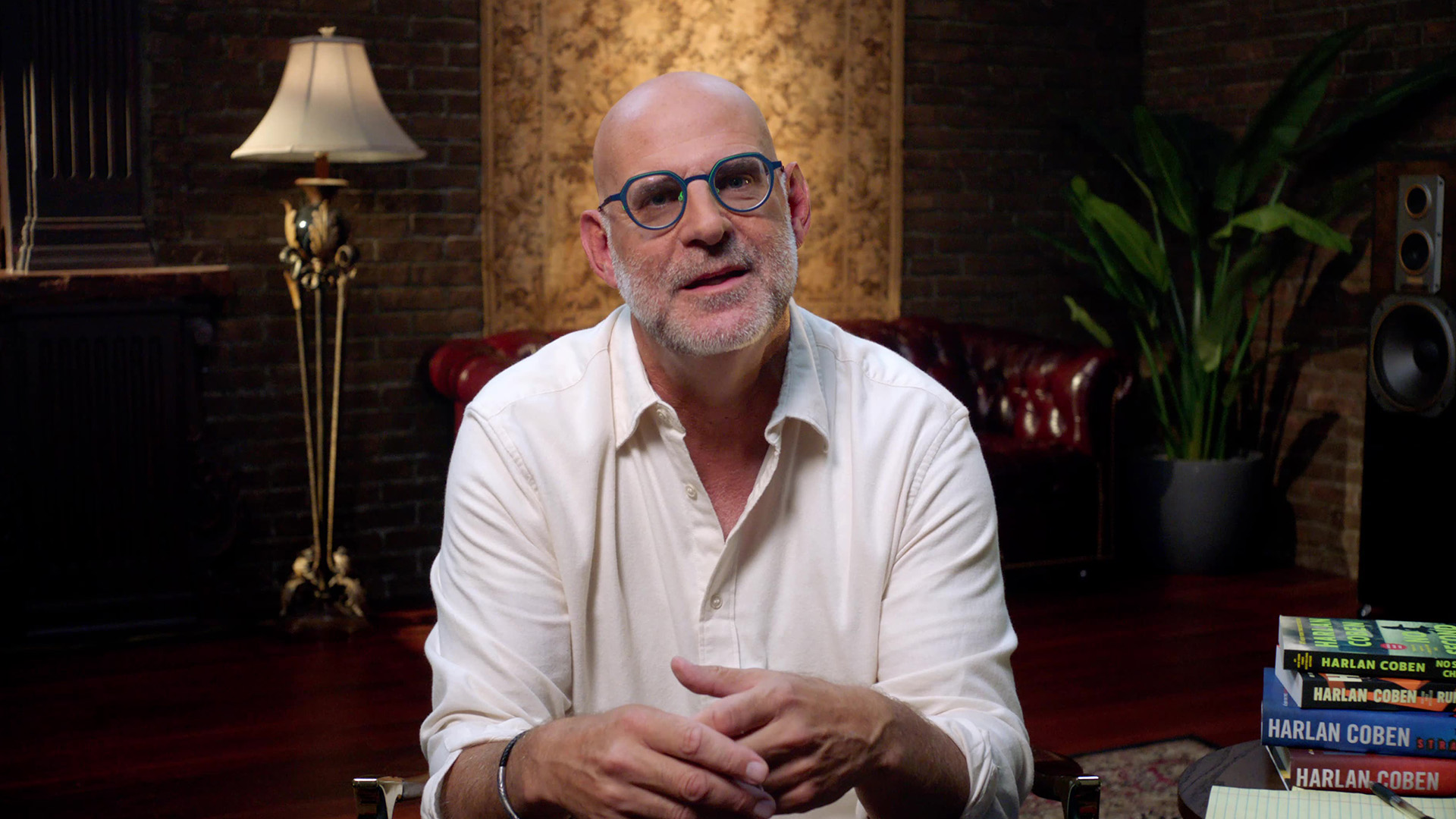
Writer’s block doesn’t have to stop you in your tracks. Harlan shares some of his tips for overcoming obstacles and procrastination, and getting the work done.
Lesson
Captions available
Duration
12 minutes
Course notes PDF
Maestro
Rating
Explore lesson transcript
The bane of every writer's existence... writer's block. It's the worst thing. Everybody goes through it. Everybody wants to know how they can fix it. Everybody wants to know how they can work through it. I want to reframe it. I want to reframe your idea of writer's block. Because the problem with the term writer's block is I'm picturing you're travelling down the road. We've talked about the journey. You're travelling down the journey and all of a sudden this gigantic block of concrete has just dropped in front of you. And the only way that you can get through it is to somehow hammer and punch and use your head to hit it in order to break it apart and get through it. I think that's wrong. I think perhaps the way to think of it is not always to just barrel through, try to punch your way through, try to kick your way through. But sometimes that block is telling you to take another route. You can go around the block. You can back up and turn right. You can back up, you can turn left. You could try to climb over it. The idea is it's not necessarily a block. It's probably encouraging you to do something different. At times, it actually is a positive. Maybe your story right now is a little too smooth. Maybe your hero is going through stuff that isn't enough. He has to have more obstacles in his way. So you, as a writer, are being thrown into that obstacle. Now, when you're going through it, it feels terrible. And I tell you, there are days that I write when the words are flowing freely. Not often, and that muse is singing on my shoulder. Not often. Most days, writing is like having a case of constipation that could kill a horse. Every word is a struggle. Every word you're fighting to get out. That's OK. That's part of the process. How do I get past this now? I'm sitting there. I've gone down my road of life. There's a giant block in the way. How do I work to get around it? First of all, I try to change up my environment. If I'm writing at night, I start writing during the day. If I'm writing in my house, I write outside my house. If I'm writing on my computer, I go back to my old pad and pen. If I'm writing on my pad and pen, which is most of the time what I do, first draft. Most of the time, I'm jotting down ideas and thoughts on this pad and then I'm going to put it on the computer. So most of the time when I have a writer's block moment, as they say, it's while I'm doing this. Then I put this down and I go straight onto the computer and word processor. If I've been working in a coffee shop, maybe I'll change up and I'll work someplace else. I'll work in a house. My own method of writing, my own writer's routine, is to constantly change my writer's routine. I don't have one. I don't like having one. You may. Again, some writers are very anal about it. They get up, they do this at the same time. That's how they get through writer's block, through routine. I am the opposite. I mentioned before, when I was writing *The Stranger.* I had never done this before but I took an Uber into the city and I felt tremendous guilt about it because I was spending the money on an Uber. So I sat in the back of the Uber and I had my pad and paper and I started to write, and I wrote really well. And so for the next three weeks, I took Ubers everywhere I went, all day long until I finished *The Stranger.* Yeah, I finished *The Stranger* in the back of an Uber on my pad. Just changing up. Just that kind of pressure. Let me see it from a different angle myself and now I am able to get around, not through. I didn't break it. I didn't break it apart. That block is still there. If you go back in time, you'll still see that block sitting there. How I went around it to finally get to the ending of the story. The other way of doing it is within the scene. You are writing a scene of three people in a room talking. It's a first person book so you are writing it from the viewpoint of one person, but what's the other two people thinking? How can I get them to get me out of it? I don't always have to have my hero be the one who's pushing at the block. It could be one of the other characters. It could be a secondary character. It could be the Chekhov gun moment. I like it better the way Mickey Spillane said it. What Mickey Spillane said, when he was having trouble getting out of a scene, just someone showed up with a gun and fired. Obviously, that's an extreme, but when you're in a moment where nothing is happening, where you can't get by it, try something crazy. Even if you don't use that crazy moment, it's going to help you get around those parts. The other part of it is motivation again. Sometimes writer's block is just you being a little bit lazy, right? Sometimes you got to get your ass kicked a little bit. Sometimes you got to be made to do it, and that's OK. So if you have writer's block, that doesn't mean go watch TV. Go do something you enjoy. No, it means you sit there and you stare at that until you get rid of it. "Read the phone book!" As we used to say in the old days. There's no phone books anymore. Do something really boring until you're so bored you're going to figure out a way around that writer's block. Take a walk. Some writers do this. I got to admit, I'm not the best at taking walks. But sometimes I'll take a walk and I will have my phone up to my mouth and I'll use one of those dictations or I'll even tape it and I'll just start talking out the problem. I'll actually tell the story to myself. And you're surprised how often you come up with something new. Sometimes writer's block isn't because you're stuck and there are no avenues. Sometimes it's because there's too many avenues. We talked a little bit before about how choice makes you freeze up. It's the same thing here. The problem isn't that there's nowhere to go. The problem is there's too many places to go and you're afraid you're going to go down the wrong route. It's life. Life is a series of sliding doors, right? If you went right instead of left, your whole life would be different. It's OK, though. Your story is going to be one way or the other. Take one of those routes. Commit to it. Here's the beauty of being a writer. You can always redo it. Real life, you can't go back in time and edit. But in books, you can. So choose one of those avenues that's in front of you. Take one of those choices. Don't let it paralyse you. And if it doesn't work out... 99% of the time it will. But if it doesn't work out, you can always go back to where that block was created and go to the left instead of the right and see what it does. In your mind's eye, you're already doing it, right? That's why you're being paralysed. You're at that block. You can go right or left. You can go back or forward. So you decide. "I don't know which is going to be..." Just take one. Take one for now, and you can always go back if it's the wrong one. You'll realise it right away. Write yourself into corners and then figure your way out of corners. This also brings us back to our writer's mind frame we talked about, you're a writer now, and part of being a writer is tapping into your childhood. Tapping into your childhood curiosity. Children are wonderfully curious. The most intelligent adults I know, the most successful adults I know, and the best writers I know, all have a child-like curiosity. I'll be with them at some kind of lecture or talk and they'll be the people in the front row with their eyes wide open, listening to every single thing that goes on. So tap into that. Think of what you would have done as a child. Again, that's why I like to think on paper sometimes. Draw pictures, even, and I'm a terrible artist. But draw, write, create, paint, whatever you do, that's going to get you to that next level. You just have to sort of change your mind frame. Get that inner child working again. The adult in you is scared and that writer's block is scaring you. The child in you sees that writer's block as a fun challenge, a cool way around it. Get that part of you to take over for a little while. And writer's block, again, is part of that process. What does that mean? That means it bleeds into everything else we've talked about. Plot is character, character is setting, setting is plot. Bleeds in. Writer's block is part of the process. It can help you create cool things. Let me give one quick example. I was writing a book called *Back Spin*, a Myron Bolitar novel. And there's a scene when Myron Bolitar is going to a no-tell motel. You know, one of those that say "Now featuring towels." "Hourly rates, colour TV." That was always my favourite sign. It says colour TV, the C is in red, the O is in orange, yellows and green. Anyway, he's going into one of these no-tell motels, hourly rate hotels, and he has to bribe the guy behind the desk in order to get the information he needs. Now, if you've watched any TV, you know exactly what's going to happen. The guy's going to have a ripped white T-shirt, it's going to be dirty, he's going to be unshaven, his hair's going to be a mess, he's going to be burping up beer, he's going to be behind a bulletproof glass. Myron's going to slide him the \$50, the guy's going to take the \$50 and go. But when Myron walked into that room, instead of that, in this dump... It's a dumpy hotel, has this beautiful concierge desk, and the guy behind the desk is a concierge with the sign "concierge" and he's wearing grey tails and he takes his job very seriously. If you're going to commit adultery here, you're going to do it in style at the crap motel. All of a sudden, we have new possibilities. It's a funnier scene. It somehow feels more real that this guy is like bragging about his mum being proud that he's the manager of this kind of a dump. And mostly, he's not going to take Myron's \$50, and Myron's not going to get the information that fast. So now Myron Bolitar has to come up with another way of getting the information. We've gotten rid of a scene that looks like a cliché that you're already writing in your head. And again, it's somehow funnier and more real to have a character like that and behaving like that than the scene that we've already seen a million times over. There's an example where writer's block is actually feeding you. Writer's block is actually helping you create new and better story. My last piece of advice is go to sleep on it. I don't love this one, I got to be honest. I'm more, as you could probably tell... my personality is not one to lay back very much. I kind of like to go forward and continue, but there are times that I do sleep on it. I, most of the time, will sleep on it with a pad next to me. I have to be honest, though. Most times when you write down what you think of in your sleep, it makes absolutely no sense. It'll be like a bear stuck in a blender flies by. You know, it'll be like no sense whatsoever because you dreamed it, it felt real. But there are times very late at night or very first thing in the morning when I'll come up with the answer. Especially first thing in the morning. I actually have one of my other little secrets, you can get this online someplace. I have a waterproof pad that's in my shower with one of those pens. I have it hung there. I oftentimes come up with ideas while I'm in the shower. So go to bed on it. Think of it as the last thing is what that writer's block is. Try to come up with that story. Most of the time when I'm trying to sleep and I try to think of a story, it puts me to sleep right away, which is also a sign. But when I wake up in the morning, either right then or when I'm taking that shower, there'll be times when the answer will come to you right then and there.
What you'll learn
Join Harlan as he shares his secrets to building suspenseful stories, and craft novels your readers simply can’t put down.
- Perfect the art of pacing
- Master suspense, tension and plot twists
- Learn about structure, dialogue, setting and character
- Beat writer's block
- Adapt your novel for TV
- Get industry insights from Harlan’s editor and agent

Harlan Coben is the #1 New York Times author of more than 36 novels including The Boy from the Woods, Fool Me Once, Tell No One and the renowned Myron Bolitar series. His books have been published in 46 languages around the globe, and many have also been adapted into television dramas including The Stranger, Stay Close, and Shelter to name but a few. Harlan Coben has been awarded the Edgar Award, Shamus Award and Anthony Award – he was in fact the first author to win all three – and was the first writer in more than a decade to be invited to write fiction for the New York Times op-ed page. His essays and columns have appeared in many top publications including the New York Times, Parade Magazine, and Bloomberg Views.
Common Questions
-
How can I start writing if I feel stuck?
Begin by writing anything, even if it feels rough. Harlan Coben suggests changing your environment, using pen and paper, or switching perspective to spark creativity.
-
What are the best ways to overcome writer's block?
Reframe writer’s block as a creative opportunity. Change your routine, explore different character viewpoints, or take a break to return with fresh ideas.
-
What tips does Harlan Coben give for writing a compelling thriller?
Use pacing, tension, and unexpected twists. Keep readers engaged with believable characters, realistic dialogue, and layered settings.
-
How can I come up with strong story ideas?
Draw inspiration from everyday life, 'what if' questions, and unexpected scenarios. Let curiosity and small changes lead to bigger plot developments.
-
How should I start the first chapter of my book?
Open with intrigue or a problem that demands resolution. Hook readers immediately with action, mystery, or a unique voice.
-
What makes a good story structure for creative writing?
A good story has clear stakes, well-paced conflict, and resolution. Balance plot with character development to keep readers emotionally invested.